5
MINUTES

Corporate Loans
The canonical guide to the rolling 13-week forecast, and the diagnosis it produces before you borrow.
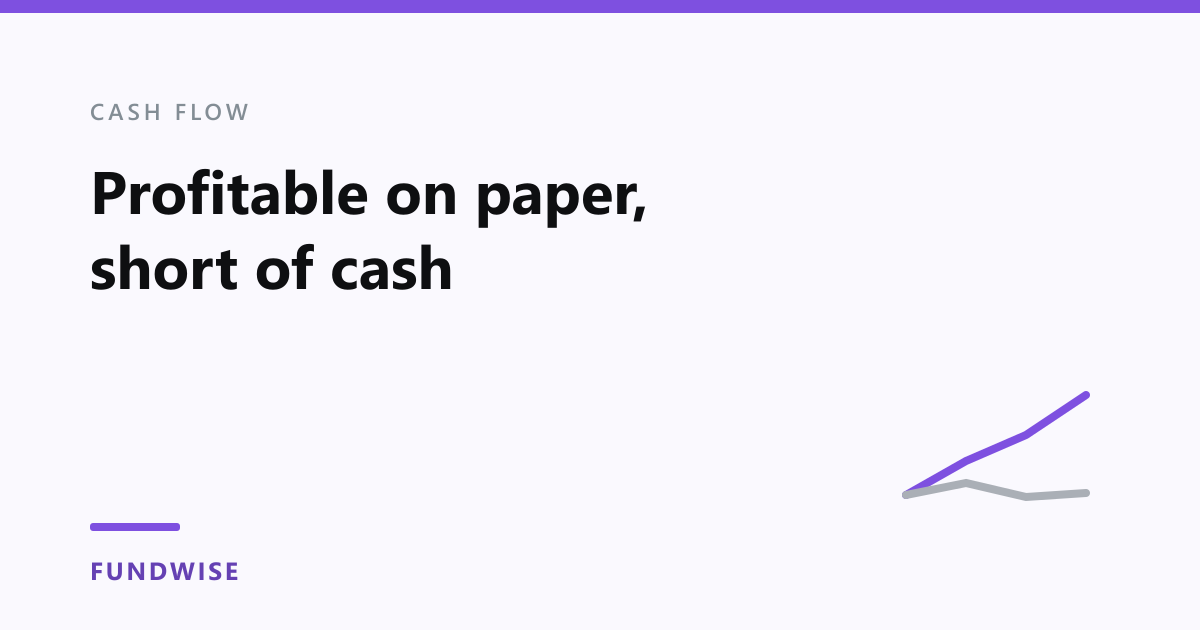
Profit and cash flow answer different questions.
Profit measures whether income earned during a period exceeds the expenses recognised for that period. Cash flow tracks when money actually enters and leaves the business. A company can record a profit and still lack the cash needed for payroll, tax or supplier payments.
Understanding the difference matters before borrowing. Financing may help a healthy business bridge a timing gap, but it can make matters worse when the underlying business is consistently unprofitable.
Consider a fictional wholesaler.
During June it delivers goods and invoices customers S$120,000. The goods cost S$78,000 and its running costs for the month are S$12,000, so it records S$30,000 of profit for June.
Now look at the bank account for the same month. Customers are allowed 60 days to pay, so the money arriving in June is S$25,000 from invoices raised back in April. Going out: S$70,000 to suppliers, for stock ordered in April and already sold, plus S$20,000 in wages.
June therefore records a S$30,000 profit and a S$65,000 fall in cash. Both numbers are correct. They are measuring different things, and neither is available to pay July's wages by itself.
Notice that the supplier payment has almost nothing to do with June's profit. It settles stock bought two months earlier. This is the ordinary state of affairs for a business carrying inventory, not a sign that something has gone wrong.
The reverse can also happen. A customer deposit may improve cash today even though the related work and costs come later. A new loan increases bank cash but is not revenue. Buying equipment consumes cash immediately, while the accounting expense may be recognised over the asset's useful life.
This example is fictional and simplified. Accounting and tax treatment should be reviewed by a qualified professional for your own circumstances.
Shows income and expenses over a period. It helps answer whether the business model is earning more than it costs.
Shows what the business owns and owes at a point in time. It can reveal cash tied up in unpaid customer invoices, inventory or equipment, as well as loans, amounts owed to suppliers and other liabilities.
What you are required to prepare depends on how the business is set up. If you run a sole proprietorship or a partnership, IRAS explains that a statement of accounts means a profit and loss account together with a balance sheet. Companies follow a separate set of reporting rules, so ask your accountant which applies to you before assuming the two are the same.
Converts plans and obligations into dates. It asks whether enough money will be available when payroll, rent, tax, suppliers and debt repayments fall due.
Accounts describe the past. A forecast helps the owner manage the next few weeks — provided the assumptions are updated honestly.
Start with opening bank cash. For each week, add receipts by the date they are realistically expected — not simply the invoice due date. Then deduct:
Calculate the closing cash position for every week. That closing balance becomes the next week's opening balance.
Use weekly rows for opening cash, customer receipts, other inflows, payroll, rent, suppliers, GST or tax, debt, capital expenditure, owner withdrawals and closing cash. Add columns for each scenario. Highlight the lowest cash point, the size of the gap and how many weeks it persists.
Run at least two scenarios:
A more exposed business should also test lower sales, higher input costs or the loss of a major customer.
A temporary shortfall with a clear recovery date may support a discussion about working-capital, receivables or revolving facilities.
A shortfall that persists after customer payments arrive may indicate weak margins, excessive overhead or other structural problems. Adding debt creates new fixed outflows and may simply push the crisis forward.
Ask:
Financing is only one response. The business can also examine:
The goal is not to avoid financing at all costs. It is to use financing for a defined timing or investment need rather than to disguise a recurring operating loss.
A clear forecast helps explain the amount required, when it is needed, what will repay it, and what happens if receipts are delayed. It does not guarantee approval — financial institutions apply their own eligibility and credit assessments.
Figures verified on 3 August 2026. Scheme parameters, rates and lender requirements change — check the primary source before relying on any figure.
Fundwise is an intermediary, not a lender. This is general information, not individual financial, legal, tax, accounting or credit advice. Financial institutions run their own eligibility and credit assessments and set all terms — we cannot guarantee approval, rate, amount or timing.
Read more about working capital loans, or get in touch to talk through your situation.